
- You are here:
- Home »
- Socket Weld Fittings
Socket Weld Fittings
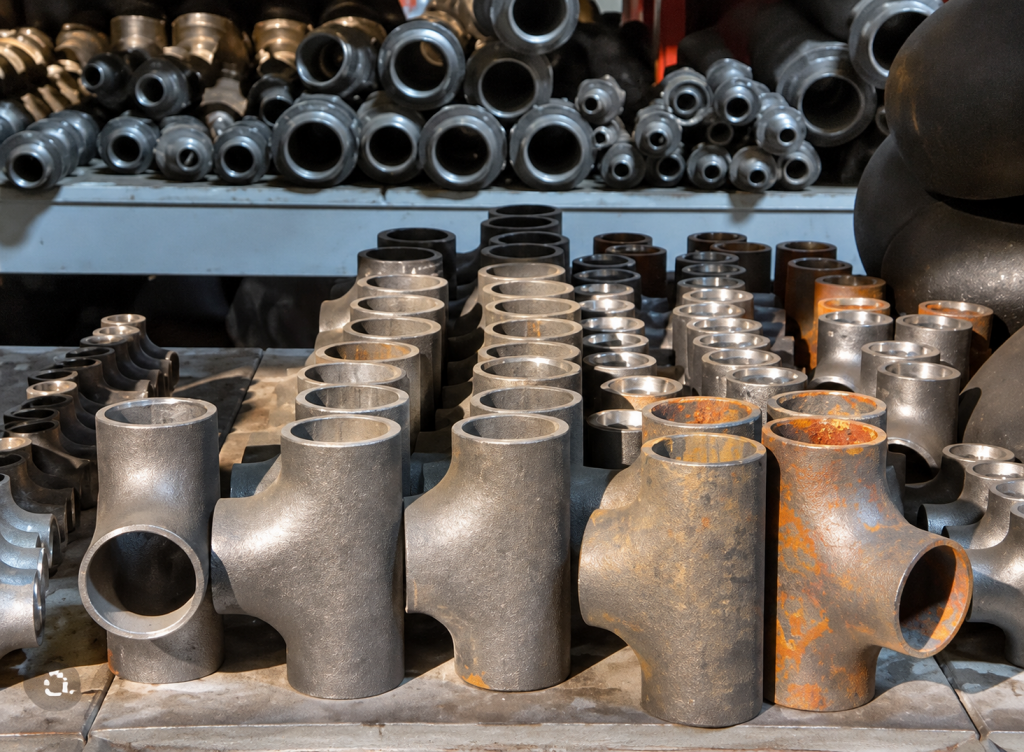
Socket Weld Fittings are forged pipe fittings designed to connect small-diameter pipes through a socket welding connection. The fitting end is machined with a recessed socket, allowing the pipe to be inserted into the fitting before an external fillet weld is applied. This connection design provides accurate pipe alignment and a compact joint structure, making socket weld fittings suitable for pressure piping systems where installation space, connection reliability, and dimensional control are important.
Manufactured according to ASME B16.11, socket weld fittings are commonly supplied in carbon steel, stainless steel, and alloy steel materials, including ASTM A105 carbon steel, ASTM A182 stainless steel and alloy steel grades. They are available in pressure classes such as Class 3000, Class 6000, and Class 9000, covering various small-bore piping requirements in industrial applications.
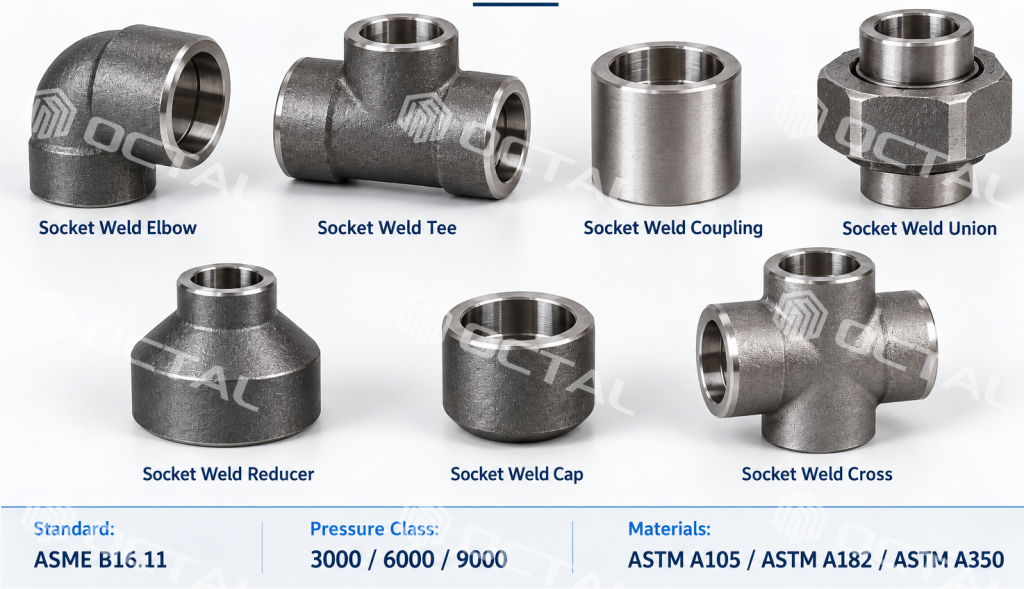
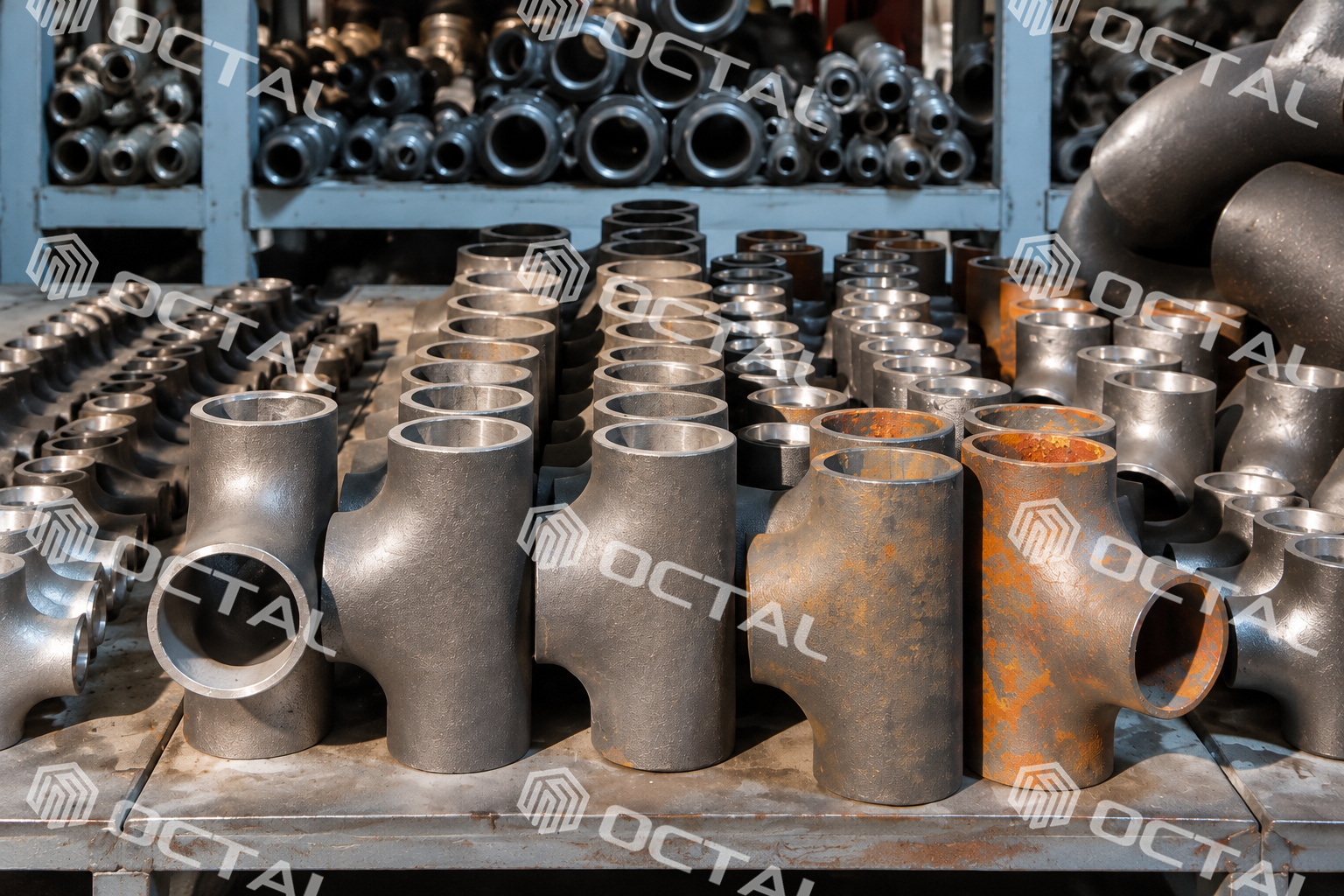
Socket weld fittings are mainly used for small diameter pressure piping systems, typically including instrument piping, hydraulic lines, steam and utility systems, chemical processing units, oil and gas auxiliary piping, and other applications where threaded connections may not provide sufficient sealing performance or where butt welding is unnecessary for the pipe size. Common fitting types include socket weld elbows, tees, couplings, reducers, unions, and caps, which are selected according to pipe size, pressure rating, material compatibility, and service conditions.
For engineering procurement, the performance of socket weld fittings depends on more than the fitting dimensions. Material traceability, socket dimensions, pressure class selection, welding compatibility, and inspection documentation are essential factors to ensure the connection meets project requirements.
Socket Weld Fittings Design Features and Connection Structure
Socket weld fittings are manufactured with a recessed socket bore, which creates a controlled insertion area between the pipe end and the fitting body. This structure allows the pipe to be positioned inside the fitting before welding, helping maintain alignment during fabrication.
The main design characteristics include:
| Design Feature | Engineering Purpose |
| Socket bore | Provides a controlled pipe insertion depth and improves joint positioning before welding |
| Forged body construction | Provides consistent mechanical properties and structural reliability compared with cast fittings |
| Fillet weld connection | Enables external welding around the pipe-to-fitting joint for small-bore pressure piping |
| Compact fitting geometry | Reduces installation space requirements compared with larger butt weld connections |
| Machined socket dimensions | Ensures compatibility between fitting bore and connected pipe outside diameter |
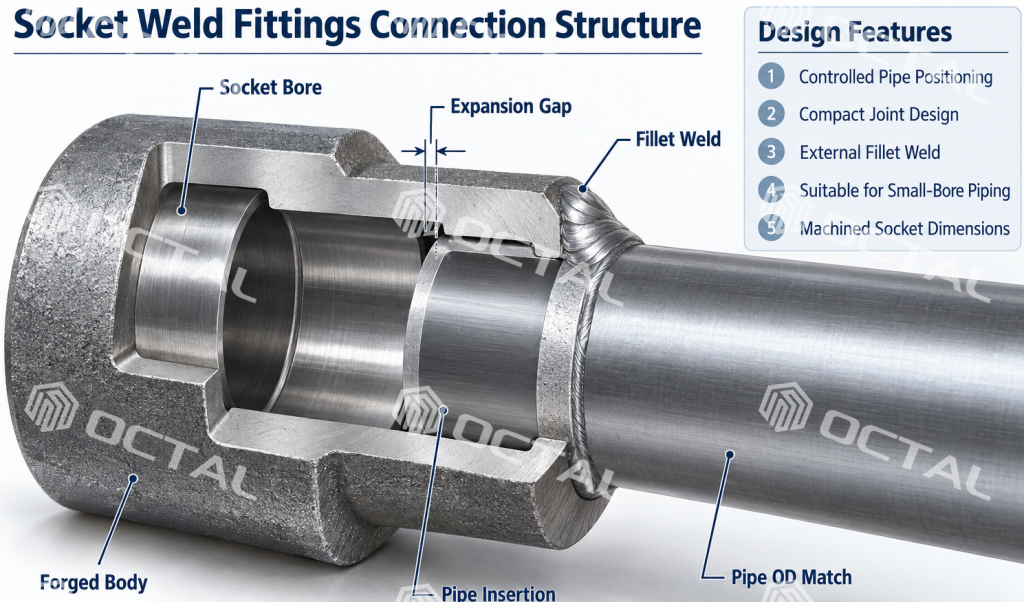
The socket weld design is particularly suitable for piping systems where dimensional accuracy and installation control are important. However, proper socket depth, pipe alignment, welding procedure qualification, and material compatibility must be verified during fabrication to avoid issues such as incomplete fusion, excessive welding stress, or service leakage.
Socket Weld Fittings Standards and Specifications
Socket weld fittings are mainly manufactured according to ASME B16.11 Forged Fittings, Socket-Welding and Threaded. This standard defines fitting dimensions, pressure classes, tolerances, marking requirements, and material requirements.
Applicable Standards
| Standard | Description |
| ASME B16.11 | Forged Socket Welding and Threaded Fittings |
| ASTM A105 | Carbon Steel Forgings for Piping Components |
| ASTM A182 | Stainless Steel and Alloy Steel Forgings |
| MSS SP-79 | Socket Welding Reducing Inserts |
| MSS SP-95 | Swage Nipples and Bull Plugs |
| ASME B31.3 | Process Piping Installation Requirements |
Socket Weld Fittings Pressure Classes
Socket Weld Fittings are classified by pressure class rather than pipe schedule. According to ASME B16.11, forged socket welding fittings are generally supplied in Class 3000, Class 6000, and Class 9000 ratings. The selected class represents the pressure capability of the fitting under specified material and temperature conditions.
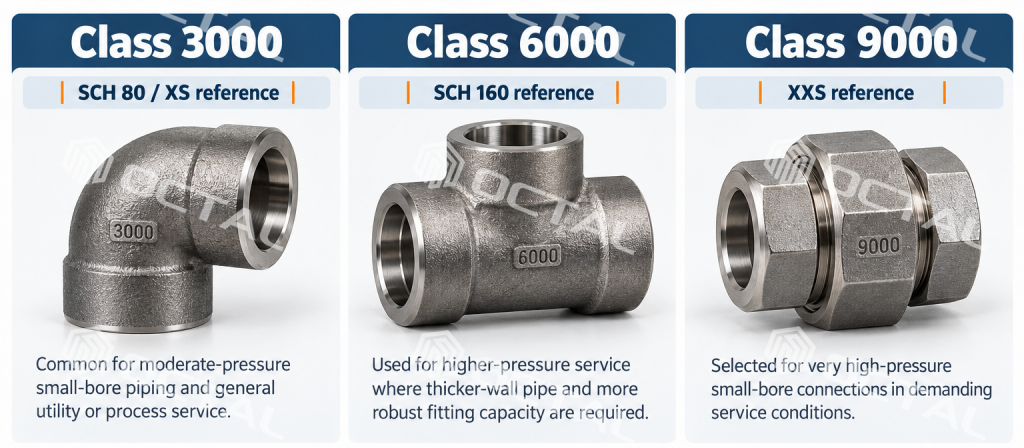
The pressure class should be selected together with the connected pipe specification, including pipe schedule, material grade, design pressure, and operating temperature. Although socket weld fittings are not identified by schedule number, they are commonly matched with heavier wall pipe systems where the pipe wall thickness provides sufficient strength for welded connections.
| Socket Weld Pressure Class | Typical Pipe Schedule Compatibility | Common Service Application |
| Class 3000 | SCH 80 / Extra Strong (XS) reference | General pressure piping, utility systems, instrument piping |
| Class 6000 | SCH 160 reference | Higher pressure process piping and demanding service conditions |
| Class 9000 | XXS reference | High pressure small-bore piping requiring maximum wall thickness |
Factors Affecting Pressure Class Selection
When specifying socket weld fittings, engineers normally evaluate the following factors:
| Selection Factor | Engineering Consideration |
| Design pressure | Determines the minimum pressure rating required for the fitting connection |
| Operating temperature | Higher temperatures may reduce allowable pressure depending on material grade |
| Material grade | Carbon steel, stainless steel, and alloy steel have different pressure-temperature ratings |
| Pipe wall thickness | The connected pipe schedule must be compatible with the selected fitting class |
| Piping code requirement | ASME B31.3, B31.1 or project specifications may define applicable design criteria |
For example, a Class 3000 ASTM A105 carbon steel socket weld elbow and a Class 6000 ASTM A182 F316 stainless steel socket weld tee may have the same nominal pipe size but different allowable pressure limits due to differences in material strength, temperature rating, and design requirements.
Proper pressure class selection helps prevent connection failures caused by mismatched components, excessive operating loads, or unsuitable material combinations.
Socket Weld Fittings Types
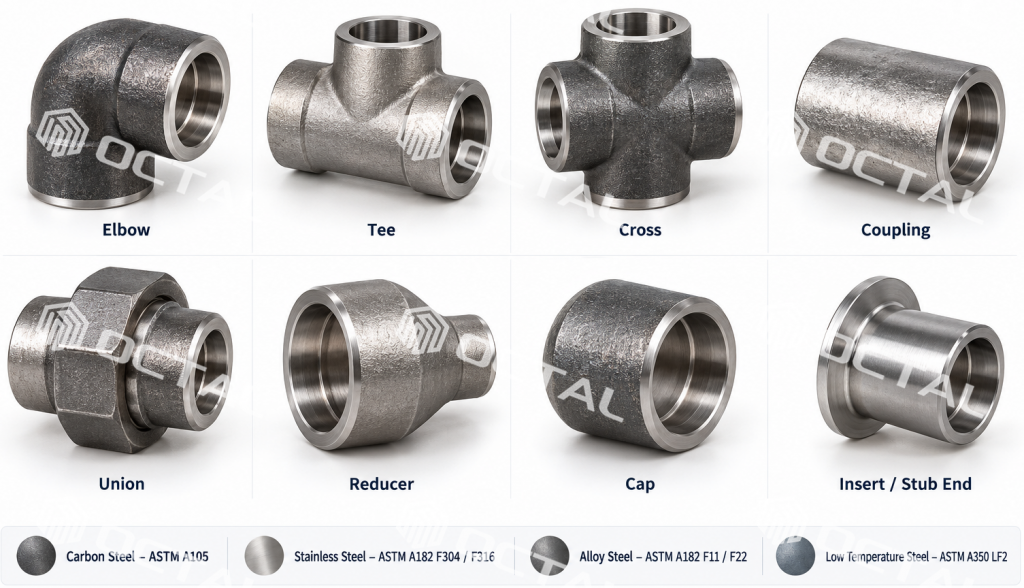
Octal Pipe Fittings supplies forged socket weld fittings in various configurations for industrial piping connections.
| Type | Application |
| Socket Weld Elbow | Changes piping direction in compact systems |
| Socket Weld Tee | Creates branch connections |
| Socket Weld Cross | Multi-direction flow distribution |
| Socket Weld Coupling | Connects two pipe sections |
| Socket Weld Union | Allows easier maintenance separation |
| Socket Weld Reducer | Connects different pipe sizes |
| Socket Weld Cap | Closes piping ends |
| Socket Weld Stub End / Insert | Special connection applications |
Socket Weld Fittings Materials
Material selection depends on service conditions including temperature, pressure, corrosion environment, and process medium.
| Material | Common Specification | Typical Application |
| Carbon Steel | ASTM A105 | General pressure piping, utilities |
| Stainless Steel | ASTM A182 F304/F316 | Corrosive and hygienic applications |
| Alloy Steel | ASTM A182 F11/F22 | High temperature service |
| Low Temperature Steel | ASTM A350 LF2 | Low temperature environments |
Socket Weld Fittings Dimensions and Size Range
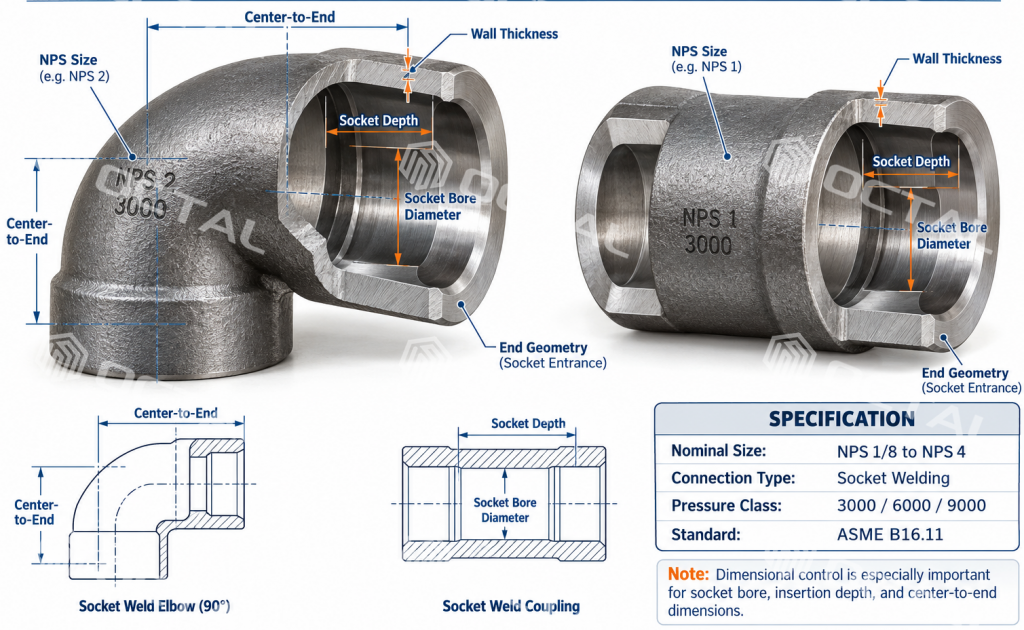
Socket weld fittings are specified by Nominal Pipe Size (NPS) and pressure class rather than by fitting outside diameter alone. According to ASME B16.11, these forged fittings are mainly supplied for small-bore piping systems, where accurate socket dimensions and proper pipe insertion fit are required to achieve a reliable welded connection.
The available dimensions depend on the fitting type, pressure class, material grade, and applicable manufacturing standard. Common socket weld fitting specifications include:
| Parameter | Specification Range |
| Nominal Size | NPS 1/8 to NPS 4 |
| Connection Type | Socket Welding (SW) |
| Pressure Class | Class 3000, Class 6000, Class 9000 |
| Fitting Types | Elbow, Tee, Cross, Coupling, Union, Reducer, Cap |
| Materials | Carbon Steel, Stainless Steel, Alloy Steel |
| Manufacturing Standard | ASME B16.11 |
| Material Standards | ASTM A105, ASTM A182, ASTM A350 (as applicable) |
Key Dimensional Considerations
For socket weld fittings, dimensional control is not limited to the outside appearance of the fitting. The socket geometry directly affects welding quality and connection performance.
| Dimension Feature | Engineering Importance |
| Socket bore diameter | Ensures compatibility with the connected pipe outside diameter |
| Socket depth | Controls pipe insertion position before welding |
| Wall thickness | Maintains pressure capability under the selected class rating |
| Center-to-end dimensions | Ensures correct piping layout and installation fit-up |
| End preparation | Supports proper welding procedure and joint quality |
When ordering socket weld fittings, buyers should confirm the NPS size, fitting type, pressure class, material grade, applicable standard, and inspection requirements to ensure compatibility with the complete piping system.
Socket Weld Fittings vs Butt Weld Fittings
Socket weld fittings and butt weld fittings are selected for different piping conditions. The main differences are related to connection method, applicable pipe size, pressure selection, and installation requirements.
| Comparison | Socket Weld Fittings | Butt Weld Fittings |
| Standard | ASME B16.11 | ASME B16.9 |
| Manufacturing | Forged fittings | Butt weld fittings formed from pipe materials |
| Connection | Pipe inserted into socket and joined by fillet weld | Pipe ends aligned and joined by butt weld |
| Typical Size | Mainly small-bore piping (NPS 1/8–4) | Medium and large diameter piping |
| Pressure Selection | Class 3000, 6000, 9000 | Based on pipe schedule and wall thickness |
| Common Applications | Instrument, utility, and auxiliary piping | Main process and transmission piping |
Socket Weld Joint Design and Welding Considerations
The performance of a socket weld connection depends heavily on installation control.
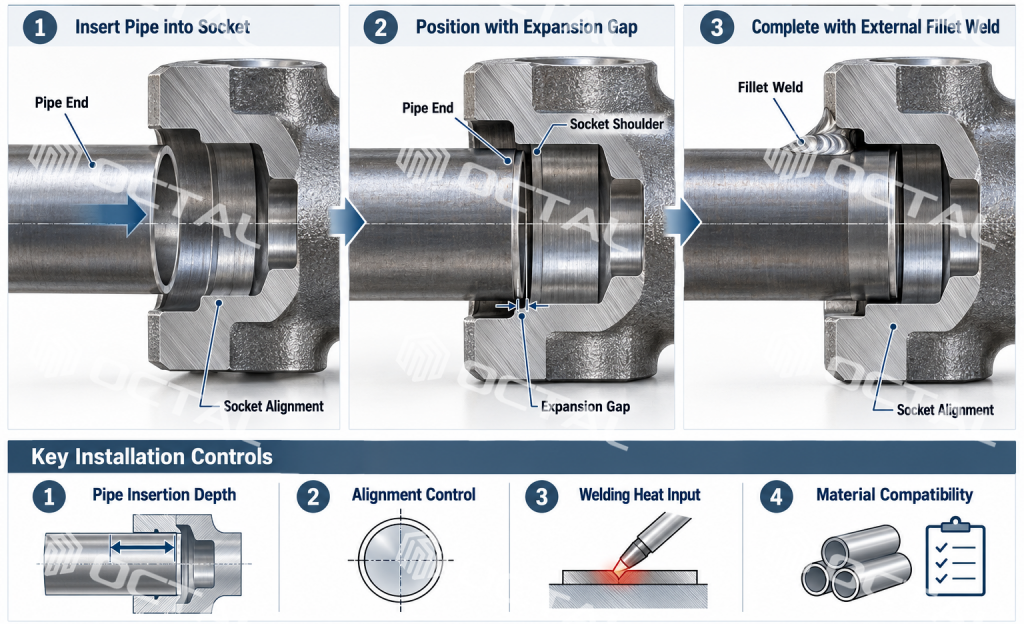
Unlike threaded fittings, socket weld fittings eliminate thread leakage paths. However, correct installation requires attention to:
- pipe insertion depth
- socket alignment
- welding gap
- heat input control
A typical installation requires a small expansion gap between the pipe end and socket shoulder to accommodate thermal expansion during welding.
Socket Weld Installation Risk Control
| Potential Issue | Control Method |
| Incorrect pipe insertion | Verify socket depth before welding |
| Misalignment | Control socket bore concentricity |
| Excessive welding heat | Follow qualified welding procedure |
| Material mismatch | Verify MTC before fabrication |
| Internal crevice risk | Select suitable service conditions |
Manufacturing Process and Quality Control
Socket weld fittings are manufactured through controlled forging, heat treatment, machining, and inspection processes to ensure dimensional accuracy, mechanical performance, and material traceability. The production process starts with raw material verification, including chemical composition and heat number confirmation, followed by forging to achieve a consistent grain structure. After heat treatment, fittings undergo machining operations to control critical dimensions such as socket depth, bore size, and end geometry.
During final inspection, each fitting is checked for dimensional compliance, surface condition, marking accuracy, and applicable quality requirements. Octal provides inspection documentation including EN 10204 3.1 material certificates, dimensional inspection reports, hardness test records, PMI reports, and NDT reports when required. These records establish traceability from raw material heat identification to finished fitting delivery.
Key manufacturing and inspection controls include:
- Material traceability: Heat number verification and MTC documentation ensure the supplied material matches the specified grade.
- Forging and heat treatment control: Mechanical properties and hardness are verified according to material requirements.
- Machining accuracy: Socket bore, insertion depth, and fitting dimensions are controlled to ensure proper pipe fit-up.
- Final inspection: Appearance, marking, dimensions, and inspection records are reviewed before shipment.
Through controlled manufacturing and documented inspection procedures, socket weld fittings can be supplied with consistent dimensions and reliable performance for industrial piping applications.
Socket Weld Fittings Applications
Socket weld fittings are mainly used in small-bore pressure piping systems where compact installation, accurate alignment, and reliable welded connections are required. Their forged construction and socket welding design make them suitable for piping systems that require controlled assembly and pressure integrity without the need for large-diameter butt welding preparation.
In instrumentation, hydraulic, and utility piping systems, socket weld fittings are commonly used for small-diameter connections in control lines, sampling systems, steam lines, and auxiliary piping. These applications usually require stable connections in limited installation spaces, where dimensional accuracy, material compatibility, and resistance to leakage are important factors during operation and maintenance.
In oil and gas, chemical processing, and industrial process facilities, socket weld fittings are often selected for auxiliary process piping, pressure instrument connections, and compact equipment connections. Engineers typically evaluate the fitting pressure class, material grade, operating temperature, and inspection documentation to ensure the connection meets the requirements of the complete piping system.
The selection between socket weld and butt weld fittings depends on the piping design, operating conditions, and project requirements. Socket weld fittings are often preferred for compact small-bore systems where installation space and alignment control are important, while butt weld fittings are commonly used for larger piping systems requiring full penetration welding and continuous flow paths.
Why Choose Octal Socket Weld Fittings
Octal supplies forged socket weld fittings with a focus on specification accuracy, material control, and reliable project documentation. The fittings are manufactured according to applicable standards such as ASME B16.11, with material options including carbon steel, stainless steel, and alloy steel to meet different pressure, temperature, and service requirements.
For international piping projects, Octal emphasizes traceability throughout the supply process. Material heat numbers, inspection records, and quality documents can be provided to support customer verification and project requirements. Before production, technical details including fitting type, NPS size, pressure class, material grade, and inspection requirements are reviewed to reduce specification mismatches and procurement risks.
With experience in industrial piping components, Octal supports customers with technical communication, specification confirmation, and customized documentation requirements. This approach helps ensure that socket weld fittings are supplied with the correct dimensions, material compliance, and documentation package required for installation and project acceptance.
FAQ
What is the standard for socket weld fittings?
Socket weld fittings are mainly manufactured according to ASME B16.11, which specifies dimensions, pressure classes, marking and material requirements for forged socket-welding fittings.
What is the difference between Class 3000 and Class 6000 socket weld fittings?
The difference is mainly the pressure rating and corresponding wall thickness requirements. Class 6000 fittings are designed for higher pressure service and are commonly matched with heavier pipe schedules.
Are socket weld fittings suitable for high pressure piping?
Yes. Socket weld fittings are commonly used in high-pressure small-bore piping systems when the selected pressure class, material grade and installation procedure meet project requirements.
How do I select socket weld fitting materials?
Material selection depends on fluid medium, operating temperature, corrosion conditions, pressure requirements and applicable piping codes.