
- You are here:
- Home »
- Threaded Fittings
Threaded Fittings
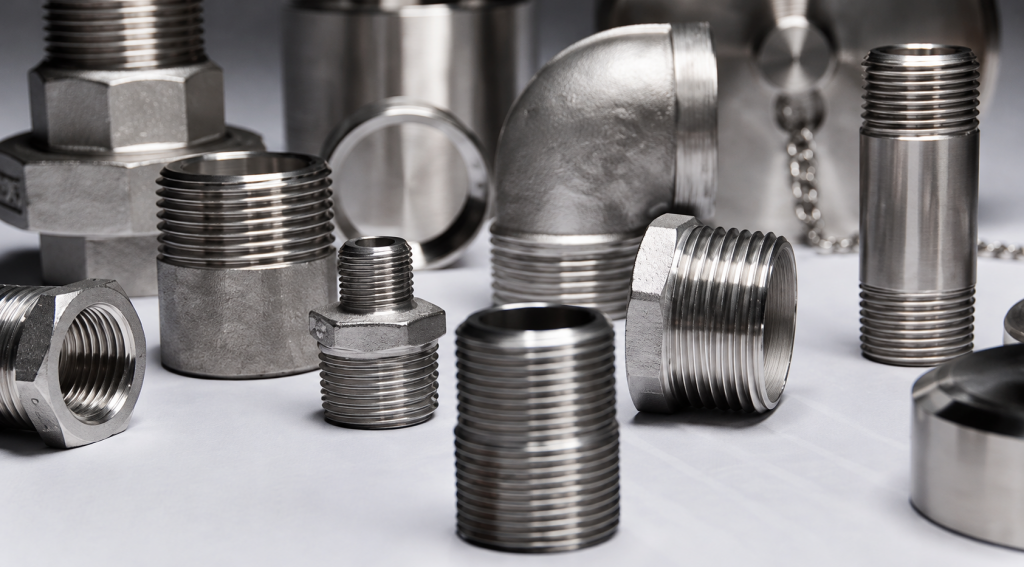
Threaded fittings are forged pressure-containing components designed to connect small-bore piping systems through threaded joints. Manufactured according to ASME B16.11, these fittings provide a mechanical connection method where thread accuracy, pressure class selection, material compatibility, and inspection traceability directly affect sealing performance and long-term reliability.
Unlike welded fittings that require permanent joining, threaded fittings allow easier installation, maintenance, and replacement in piping systems where hot work restrictions, frequent modification, or limited installation space are important considerations. They are commonly used for instrumentation lines, utility piping, hydraulic systems, and auxiliary process piping with relatively small pipe sizes.
Octal Pipe Fittings supplies forged threaded fittings in carbon steel, stainless steel, and alloy steel materials, with common pressure classes including Class 2000, Class 3000, and Class 6000. Products are available in NPS 1/8 to NPS 4 sizes with thread configurations including NPT, BSPT, and BSPP according to project requirements.
For industrial procurement, the key evaluation points are not only fitting dimensions but also thread compatibility, forging quality, heat treatment control, material certificates, and inspection records before shipment.
What Are Threaded Fittings?
Threaded fittings are forged fittings with machined threads at the connection ends, allowing pipes and fittings to be assembled by screwing the threaded sections together. The connection relies on accurate thread engagement and proper sealing methods to maintain pressure containment.
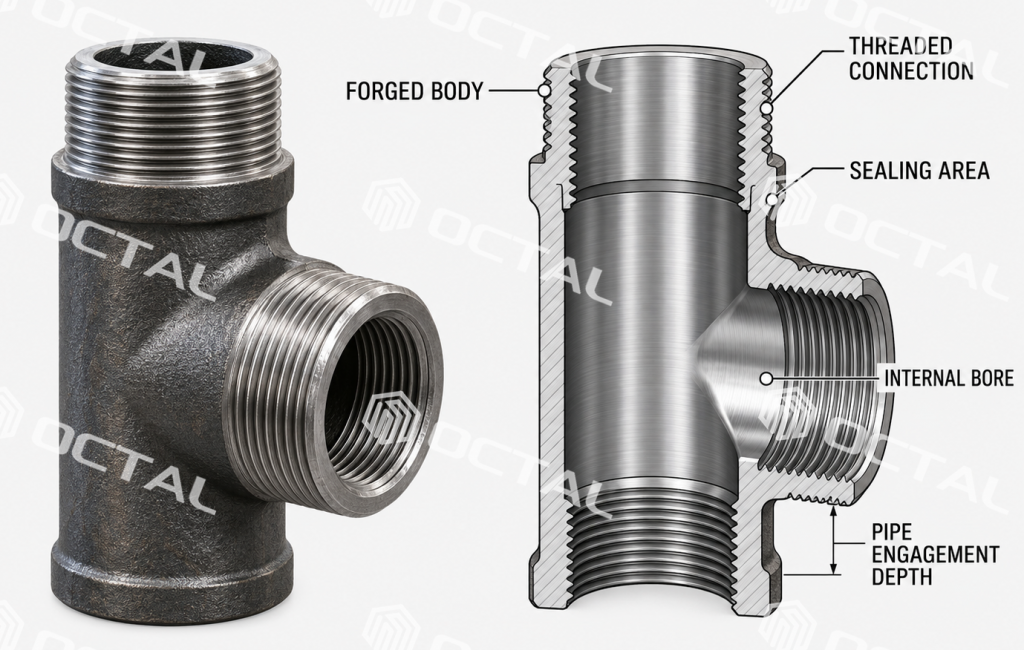
A typical threaded fitting consists of:
| Component | Function |
| Forged body | Provides pressure resistance and mechanical strength |
| Threaded end | Creates the mechanical connection with pipe or fitting |
| Internal bore | Maintains flow passage through the fitting |
| Thread sealing area | Prevents leakage after assembly |
The performance of a threaded connection depends on several factors:
| Factor | Engineering Consideration |
| Thread standard | NPT, BSPT, or BSPP must match the mating component |
| Thread accuracy | Incorrect pitch or profile may cause leakage |
| Engagement length | Insufficient engagement reduces connection reliability |
| Material selection | Must match pressure, temperature, and corrosion conditions |
| Installation torque | Improper tightening may damage threads |
For this reason, industrial buyers normally verify thread specifications, pressure class, material grade, and inspection documents before approving threaded fittings for projects.
ASME B16.11 Threaded Fittings Standards
Threaded fittings for industrial small-bore piping are generally manufactured in accordance with ASME B16.11, the standard that covers forged fittings with threaded and socket-welding ends. For buyers and engineers, this standard is important because it provides the dimensional basis, pressure-temperature classification framework, tolerance rules, marking requirements, and the general material reference system used to evaluate whether a fitting is suitable for a specified piping service.
For threaded fittings, ASME B16.11 is mainly applied to forged steel fittings used in compact piping connections where connection reliability depends not only on thread compatibility, but also on wall section, pressure class, machining accuracy, and material compliance. In practical purchasing work, this means a threaded fitting should never be selected only by nominal size. The applicable pressure class, thread form, material grade, and service condition must be reviewed together.
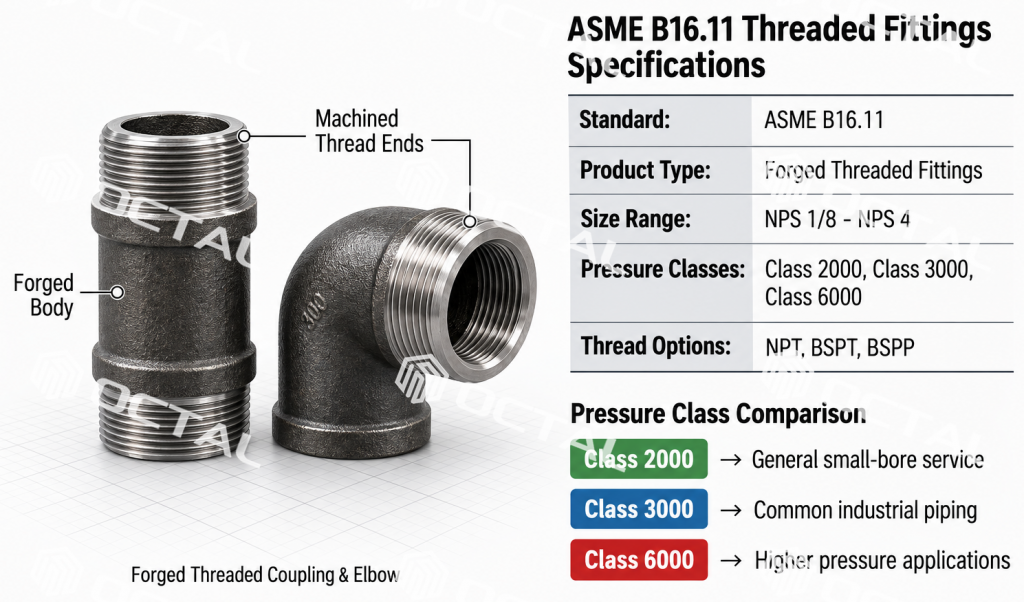
Quick Reference for ASME B16.11 Threaded Fittings
| Item | Description |
| Applicable Standard | ASME B16.11 |
| Product Scope | Forged threaded and socket-welding fittings |
| Threaded Fittings Type | Pressure-containing forged fittings with threaded ends |
| Typical Size Range | NPS 1/8 to NPS 4 |
| Pressure Classes for Threaded Fittings | Class 2000, Class 3000, Class 6000 |
| Main Evaluation Points | Dimensions, tolerances, marking, material requirements, pressure-temperature basis |
Pressure Classes of Threaded Fittings
| Connection Type | Pressure Class | Selection Focus |
| Threaded Fittings | Class 2000 | General small-bore service with moderate pressure requirements |
| Threaded Fittings | Class 3000 | Common industrial piping requiring higher pressure capacity |
| Threaded Fittings | Class 6000 | More demanding service conditions with higher pressure requirements |
The correct pressure class should be selected based on the actual operating conditions of the piping system, especially design pressure, operating temperature, material grade, and the relevant code basis used for the project. In other words, the class number is only part of the selection process. A Class 3000 or Class 6000 fitting is not chosen simply because it is “stronger,” but because its rating must align with the piping design conditions and the material performance allowed under the applicable specification.
Threaded Fittings Size, Material and Thread Options
Threaded fittings are selected according to connection size, thread configuration, material grade, and service requirements. The following table summarizes the common supply range.
| Selection Item | Available Options |
| Size Range | NPS 1/8 – NPS 4 |
| Thread Forms | NPT, BSPT, BSPP |
| Fitting Types | Elbow, Tee, Coupling, Union, Bushing, Plug, Cap |
| Carbon Steel Materials | ASTM A105, ASTM A350 LF2 |
| Stainless Steel Materials | ASTM A182 F304, F316, F321 |
| Alloy Steel Materials | ASTM A182 F11, F22 |
| Manufacturing Method | Forging + Machining |
| Surface Condition | As forged / Machined / According to project requirement |
Types of Threaded Fittings
Threaded fittings are available in different configurations depending on piping layout and installation requirements.
| Type | Function | Typical Application |
| Threaded Elbow | Changes pipeline direction | Instrument and utility piping routing |
| Threaded Tee | Creates branch connections | Small-bore distribution systems |
| Threaded Coupling | Connects two threaded pipes | Pipe extension and repair |
| Threaded Union | Allows quick disconnection | Maintenance sections |
| Threaded Bushing | Reduces pipe size | Size transition connections |
| Threaded Cap | Closes pipe ends | Temporary or permanent closure |
| Threaded Plug | Seals threaded openings | Drain and pressure ports |
| Threaded Cross | Four-way connection | Compact piping arrangements |
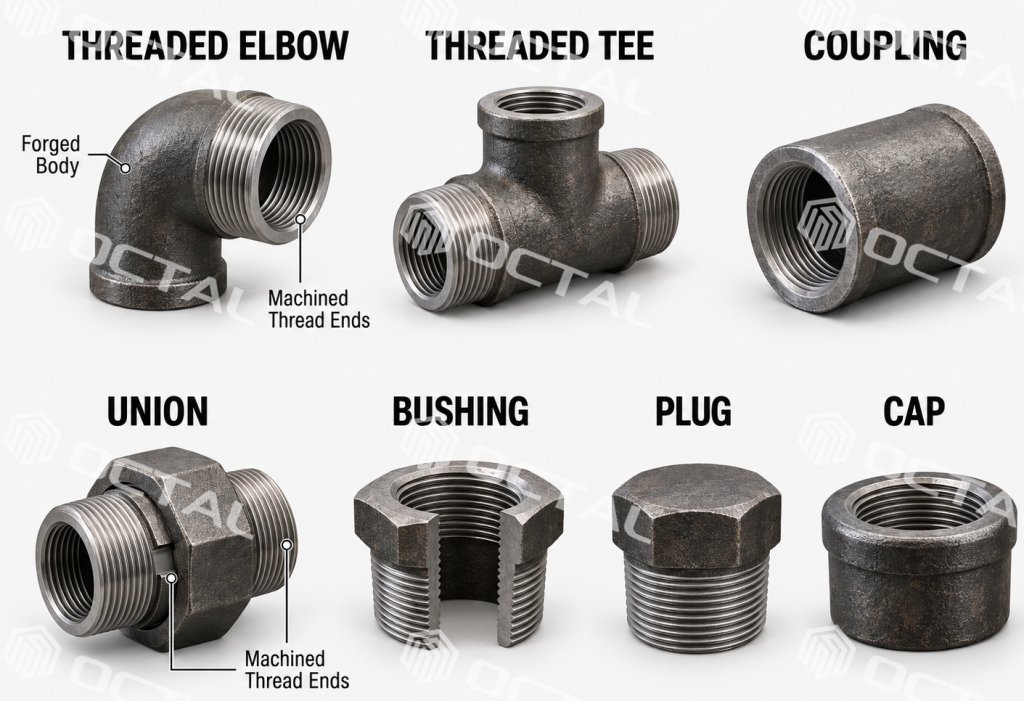
The most common industrial threaded fittings include elbows, tees, couplings, and bushings because they provide flexibility for small diameter piping modifications.
Threaded Fittings vs Socket Weld Fittings
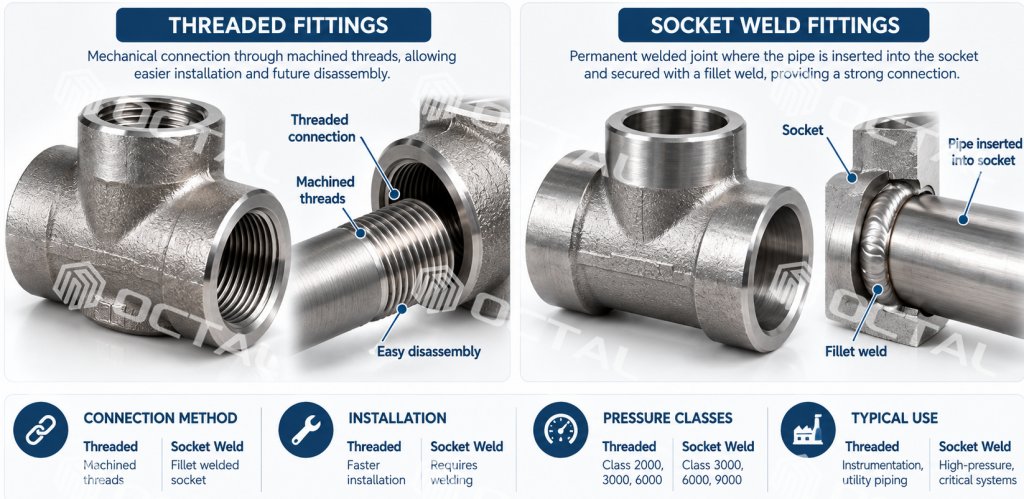
Threaded fittings and socket weld fittings are both covered by ASME B16.11 and are widely used for small-bore pressure piping systems. However, they use different connection methods and are selected according to installation conditions, maintenance requirements, pressure integrity, and project specifications.
Threaded fittings create a mechanical connection through machined threads, allowing easier installation and future disassembly. Socket weld fittings use a permanent welded joint where the pipe is inserted into the socket and secured with a fillet weld, providing a stronger connection for applications requiring higher leakage control.
The correct selection depends on the piping service, operating conditions, accessibility requirements, and welding limitations.
| Comparison | Threaded Fittings | Socket Weld Fittings |
| Connection Method | Threaded connection | Fillet welded connection |
| Installation | Faster installation and easier replacement | Requires welding process and inspection |
| Pressure Classes | Class 2000, 3000, 6000 | Class 3000, 6000, 9000 |
| Maintenance | Easier for modification and replacement | More suitable for permanent installation |
| Typical Applications | Instrumentation, utility, small-bore piping | High-pressure and critical piping systems |
Selection Considerations
When selecting between threaded fittings and socket weld fittings, engineers should evaluate the actual operating environment rather than only the fitting size.
Threaded fittings are commonly selected when:
- The piping system requires frequent maintenance or replacement;
- Hot work restrictions limit welding activities;
- The application involves small diameter utility or instrumentation lines;
- Fast installation is required.
Socket weld fittings are commonly selected when:
- Higher connection integrity is required;
- Leakage risk needs to be minimized;
- The piping system operates under more demanding pressure conditions;
- Qualified welding procedures and inspection are available.
For industrial procurement, the final selection should consider pressure class, material grade, service temperature, installation environment, and project inspection requirements. A suitable connection method helps reduce installation problems, leakage risks, and future maintenance costs.
Thread Selection Guide for Threaded Fittings
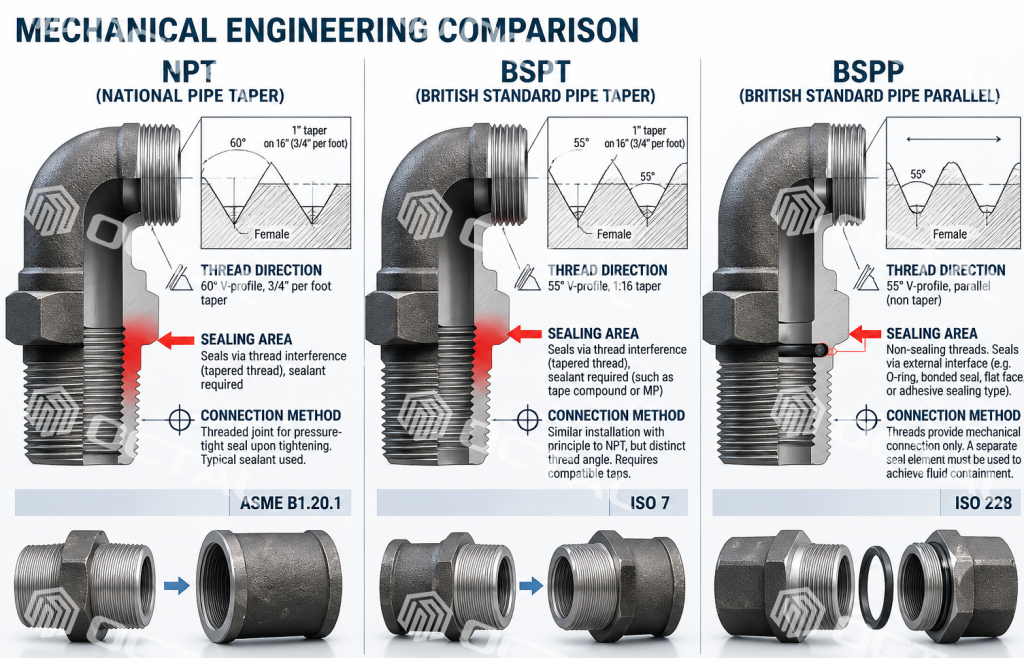
The thread type is one of the key factors affecting installation compatibility and sealing performance. Before ordering threaded fittings, the thread standard of the fitting must match the connected pipe, valve, instrument, or equipment connection. Incorrect thread selection may result in leakage, difficult installation, or connection failure during commissioning.
| Thread Type | Main Characteristics | Common Applications | Selection Consideration |
| NPT (National Pipe Thread) | Tapered thread with interference sealing between male and female threads | Oil & gas auxiliary piping, instrumentation, utility systems | Common in North American projects; thread size and gauge inspection should be confirmed before installation |
| BSPT (British Standard Pipe Taper) | Tapered thread similar to NPT but with different thread geometry | International industrial piping systems | Cannot be directly interchanged with NPT due to different thread profile and pitch |
| BSPP (British Standard Pipe Parallel) | Parallel thread requiring sealing through gasket, O-ring, or sealing face | Hydraulic systems, instrumentation connections | Requires compatible sealing design to achieve leak-free performance |
For industrial projects, thread selection should be confirmed based on:
- Connection standard specified in drawings or piping documents;
- Thread designation and size;
- Pressure rating;
- Sealing method;
- Applicable service environment.
Threaded Fittings Material Selection
The material of threaded fittings should be selected according to operating temperature, pressure conditions, corrosion environment, and fluid characteristics. Octal supplies forged threaded fittings in carbon steel, stainless steel, and alloy steel grades commonly used in industrial piping systems.
| Material Category | Common Grades | Typical Service Conditions | Main Characteristics |
| Carbon Steel Threaded Fittings | ASTM A105, ASTM A350 LF2 | General industrial piping, utility lines, oil & gas auxiliary systems | Good mechanical strength, reliable machinability, widely used for pressure piping |
| Stainless Steel Threaded Fittings | ASTM A182 F304, F316, F321 | Chemical processing, corrosive environments, clean utility systems | Better corrosion resistance and suitable for demanding environments |
| Alloy Steel Threaded Fittings | ASTM A182 F11, F22 | High-temperature and high-pressure service, power generation systems | Improved temperature resistance and mechanical performance |
Material Selection Considerations
Selecting the correct material for threaded fittings requires consideration of the complete operating environment, including temperature, pressure conditions, corrosion exposure, fluid characteristics, and project documentation requirements. Carbon steel, stainless steel, and alloy steel materials each provide different performance characteristics, so the selected grade must match the actual service conditions rather than being chosen only by availability or cost.
Operating temperature and pressure directly affect the allowable performance of the fitting material, while corrosive environments require suitable alloy selection to prevent premature degradation during service. Fluid compatibility is also important because certain process media may cause material deterioration or affect long-term connection reliability. In addition, industrial projects often require complete traceability documents, such as material certificates and inspection records, to support quality approval and commissioning procedures.
For threaded fittings, material selection should always be evaluated together with the required standard, pressure class, thread type, and application conditions. Even when the material grade is correct, an unsuitable thread configuration or pressure rating may still lead to installation difficulties, sealing problems, or connection failure during operation.
Manufacturing Process and Quality Control
Forged threaded fittings require controlled manufacturing processes to achieve reliable pressure performance, accurate dimensions, and consistent thread quality. The production process typically includes raw material verification → forging → heat treatment → machining → thread cutting → inspection → marking and packing.
During forging, the fitting body is formed to improve structural integrity and mechanical reliability. Heat treatment is then performed according to the material specification to achieve the required mechanical properties. After machining, critical dimensions such as fitting geometry, bore size, and thread profile are inspected to ensure proper connection compatibility.
Quality control focuses on three key areas: material traceability, dimensional accuracy, and thread reliability. Each fitting can be verified through heat number identification, chemical composition checks, mechanical testing, and material certificates such as MTC or EN10204 3.1 when required. Thread inspection using suitable gauges ensures that the thread profile, pitch, and engagement meet project requirements, reducing risks such as leakage, installation difficulty, and connection failure during service.
Applications of Threaded Fittings
Threaded fittings are widely used in small-bore piping systems where compact installation, connection flexibility, and convenient maintenance are required. They are commonly selected for applications such as instrumentation lines, utility piping, and auxiliary process systems.
In instrumentation and control systems, threaded fittings are used for connecting pressure gauges, valves, and measurement devices where space is limited and future adjustment or replacement may be required. Proper thread matching, sealing method, and material traceability are important to maintain connection reliability.
In utility and auxiliary piping systems, threaded fittings are commonly applied in air lines, water systems, drain connections, and other small process piping services. Their simple installation method makes them suitable for systems requiring efficient assembly and maintenance access.
For oil & gas auxiliary piping, threaded fittings are often used in instrument connections, sampling lines, and small-diameter service piping. Project requirements typically include confirmation of material grade, pressure class, thread specification, and inspection documentation before installation.
Why Choose Octal Threaded Fittings
Choosing a reliable threaded fittings supplier requires more than product availability. Buyers need consistent dimensions, confirmed material grades, accurate thread compatibility, and complete documentation to support project approval and installation.
Octal provides forged threaded fittings with controlled production processes and technical support for industrial piping applications.
| Key Advantage | Value for Customers |
| Standard Compliance | Manufactured according to ASME B16.11 and applicable ASTM material specifications |
| Material Traceability | Heat numbers, material certificates, and inspection records available for quality verification |
| Thread Accuracy Control | Thread dimensions and compatibility checked to reduce leakage and installation issues |
| Flexible Supply Capability | Supports different materials, pressure classes, sizes, and project-specific requirements |
| Technical Support | Assists with material selection, thread specification confirmation, and document requirements |
With a focus on specification accuracy, quality documentation, and project communication, Octal helps customers reduce procurement risks and ensure smoother installation during industrial piping projects.
FAQ
What standard are threaded fittings manufactured to?
Industrial forged threaded fittings are commonly manufactured according to ASME B16.11, which defines dimensions, pressure ratings, tolerances, and marking requirements.
What sizes are available for threaded fittings?
ASME B16.11 threaded fittings commonly cover sizes from NPS 1/8 to NPS 4. Actual availability depends on fitting type, material, and manufacturer capability.
What is the difference between NPT and BSP threads?
NPT is mainly used in North American systems, while BSPT and BSPP are common in international markets. They have different thread geometry and should not be mixed without confirmation.
How do I select the correct threaded fitting?
Selection should consider:
- Pipe size;
- Thread standard;
- Pressure class;
- Material grade;
- Temperature and service conditions.